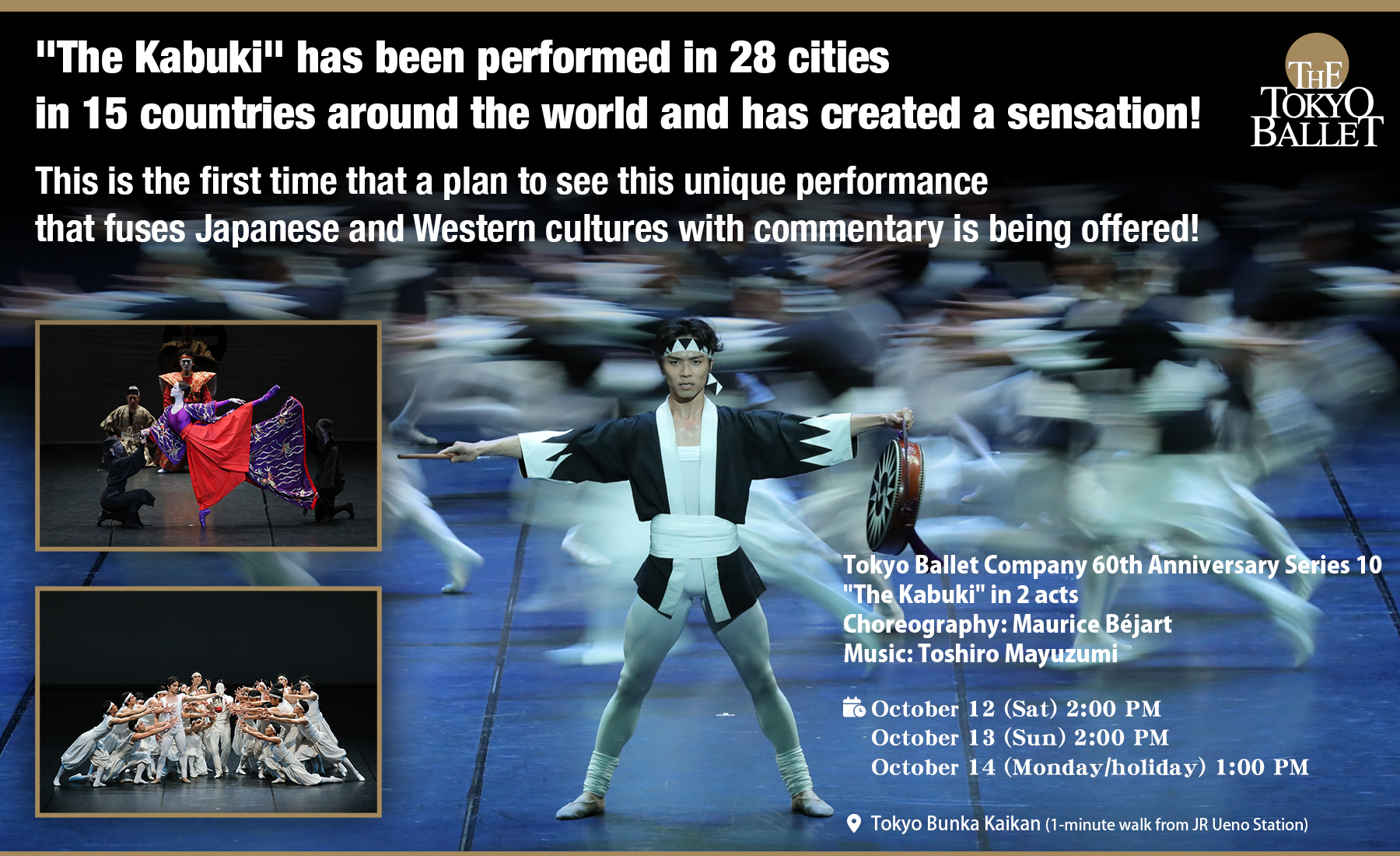
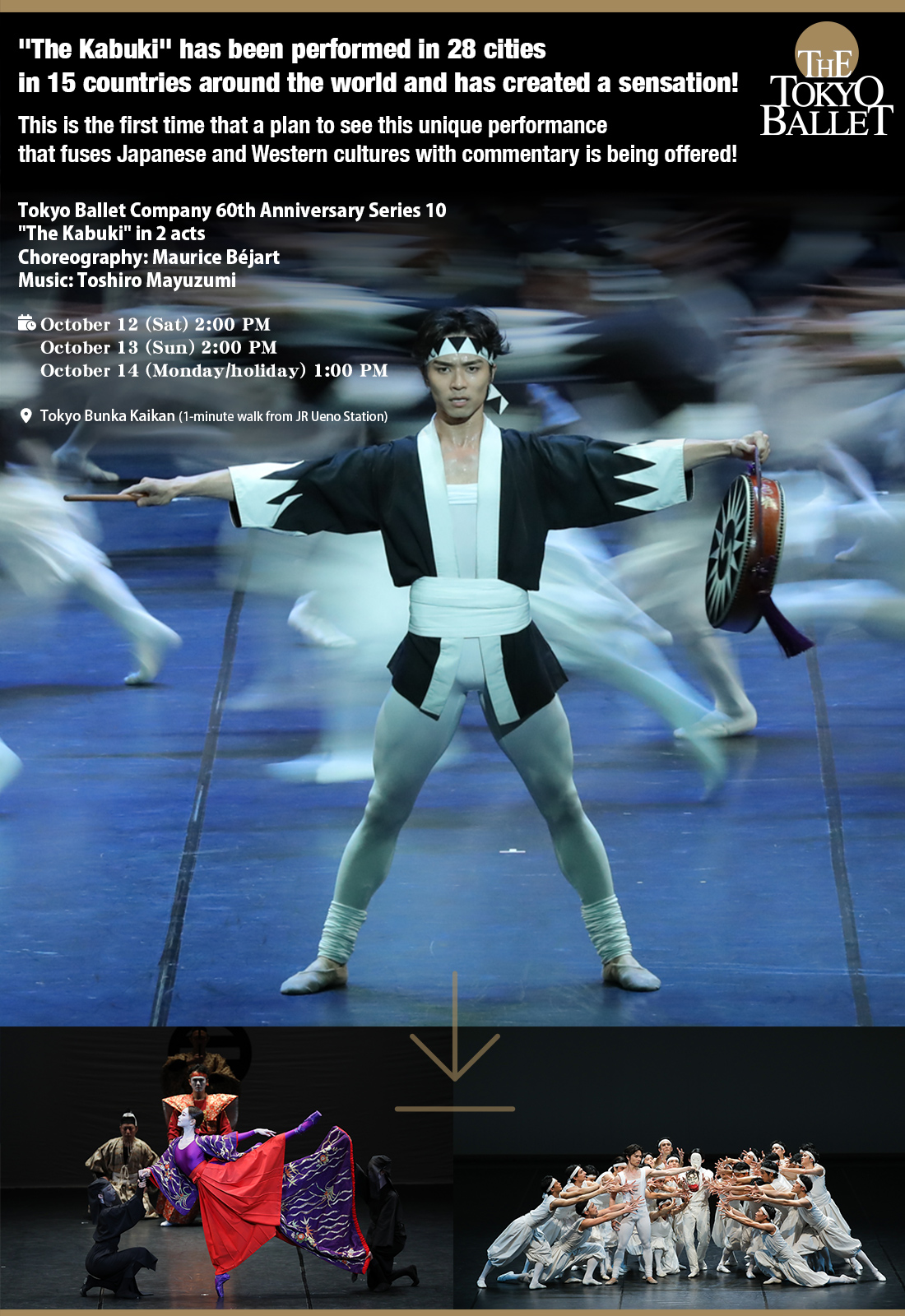
A masterpiece based on the Kabuki play "Kanadehon Chushingura"
(The Treasury of Loyal Retainers)
What is the highlight of "The Kabuki"?
A masterpiece based on the Kabuki play "Kanadehon Chushingura"
(The Treasury of Loyal Retainers)
What is the highlight of "The Kabuki"?
"Kabuki" is a traditional Japanese performing art. The main highlight of this performance is the incorporation of this traditional Japanese art form into a ballet performance that was born in the West. The choreography is by Maurice Béjart, a master of the ballet world. Since its premiere in 1986, it has been performed with great success at the Paris Opera, La Scala in Milan, and other major European theaters. Since then, it has become one of The Tokyo Ballet's most popular works and has been performed repeatedly in Japan and abroad.
The subject of the kabuki play "Kanadehon Chushingura" is the story of "Chushingura," which depicts the Ako Incident, considered a historical fact of the Edo period (1603-1868), but reset in the Muromachi period (1336-1537). The men's struggle to avenge their lord's enemies is interpreted in a way that only a Frenchman like Béjart could have done.
The first scene is in present-day Shibuya, a downtown area of Tokyo. Young people dance to the sound of rock music. Then a Japanese sword is presented to them, and the stage turns dark. As Gidayu music on the shamisen begins to flow, the young people are somehow transported back in time to the Muromachi period, and a story based on "Chushingura," known to all Japanese people, begins to unfold.
"Chushingura" depicts the spirit of "righteousness" that is uniquely Japanese.
The story incorporates a wealth of Japanese culture that has been highly acclaimed overseas.
"Chushingura" depicts the spirit of "righteousness" that is uniquely Japanese.
The story incorporates a wealth of Japanese culture that has been highly acclaimed overseas.

"Chushingura" is based on the incident in which Asano Takuminokami, lord of the Ako domain of Banshu, is said to have slain a senior government adviser, Kira Yoshihisa, with his sword in the pine hallway of Edo Castle. The story depicts a uniquely Japanese sense of "righteousness," in which 47 warriors, all of whom remained loyal to their lord, ended the incident by committing "seppuku," or ritual suicide, in a way that only a samurai could.
The Frenchman Béjart's sublimation of the Japanese samurai aesthetic into the Western art of ballet has been highly acclaimed abroad.
Performance in England
'Bold adaptation of classic Kabuki, a salute to Béjart'
(Excerpted from The Daily Telegraph, August 3, 1986)
Performance in Italy
'Tokyo Ballet's New Production of Béjart's "The Kabuki" at La Scala a Huge Success -
Like Watching a Kurosawa Film'
(excerpt from Corriere della Sera, September 11, 1986)
Performance in France
'"The Kabuki" is a fusion of cutting-edge neoclassical dance and traditional Japanese theater arts, linking East and West'
(Excerpt from le Figaro, October 18, 2001)
Tokyo Ballet Company, one of Japan's leading ballet companies
Tokyo Ballet Company, one of Japan's leading ballet companies
_2C8A9260_photo_Kiyonori Hasegawa.jpg)
Since its founding in 1964, the Tokyo Ballet Company has given approximately 3,000 performances both in Japan and abroad, making it one of Japan's leading ballet companies. In Japan, the group is based at the Tokyo Bunka Kaikan in Ueno, Tokyo, but has made a name for itself around the world with successful performances at such prestigious European opera houses as the Paris Opera, La Scala in Milan, the Vienna State Opera, the Bolshoi Theatre, the Mariinsky Theatre, and the Royal Opera House.
This performance will feature a spectacular cast, including Dan Tsukamoto, who won the lead role in "The Kabuki" at the age of 20 and has played the role of Yuranosuke for the past 14 years, and will bring you a world where the spirit of Japan and Western art are fused together.
Photos by Kiyonori Hasegawa

